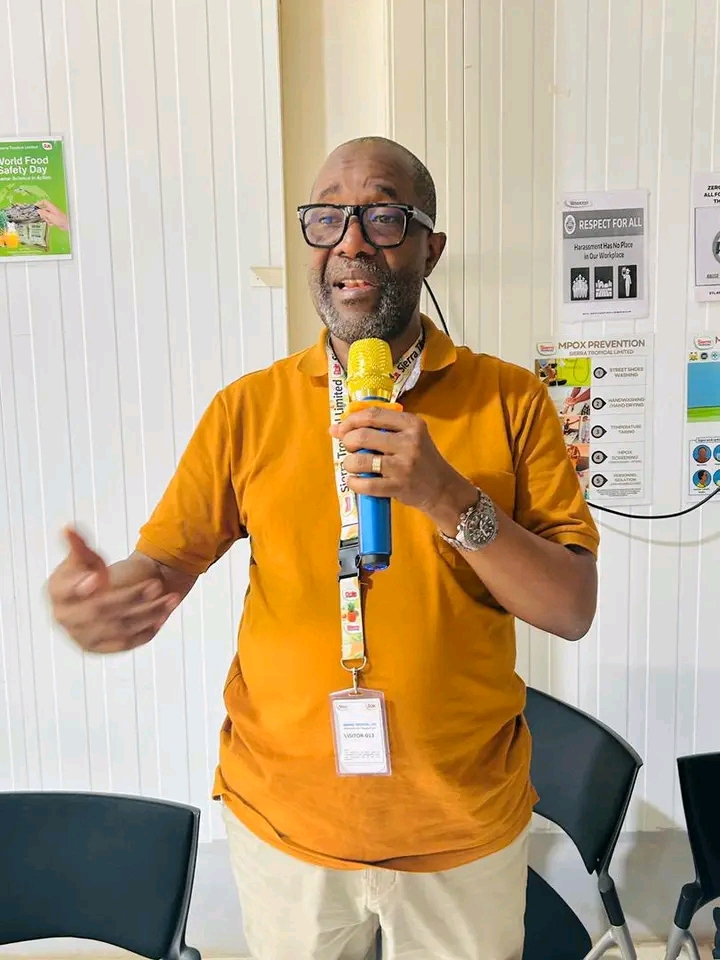
In a decisive move to address an ongoing industrial dispute, the Minister of Employment, Labour and Social Security, Mohamed Rahman Swaray, has held a consultative meeting with aggrieved workers of Sierra Tropical Limited, aimed at resolving grievances and improving working conditions. The engagement forms part of the government’s broader agenda to strengthen human capital development, implement labour market reforms, and safeguard workers’ rights across Sierra Leone. Addressing the workers, Minister Swaray emphasized that the visit underscored government’s commitment to balancing investment promotion with the protection of local labour.
“This is my second visit here. When my team and I came yesterday, we learned that certain unfortunate incidents occurred after my previous visit, though they were not officially communicated to me. Nevertheless, we remain attentive to developments on the ground,” he said. He disclosed that the high-level delegation had earlier engaged community stakeholders in Lugbu Chiefdom alongside officials from the Ministry of Local Government and Community Affairs. According to the Minister, the intervention was directed by President Julius Maada Bio, who remains committed to promoting investment while ensuring fair labour practices.
“The President is concerned about attracting investment to Sierra Leone while ensuring that Sierra Leonean workers are treated fairly in their workplaces. That is why we continue to engage communities and workers directly to resolve emerging industrial issues,” he stated. Minister Swaray further revealed that the Ministry has significantly expanded its provincial presence after years of limited staffing, with over 165 new personnel recruited to enhance nationwide service delivery. He encouraged workers to raise concerns openly, stressing that proactive dialogue remains essential in preventing industrial unrest.
Speaking on behalf of the workforce, Augustine M. Frank, a plant mechanic, highlighted grievances relating to compulsory Saturday work. He alleged that workers were persuaded to accept the arrangement under promises of additional compensation, only to later discover that the agreement had been submitted to the Sierra Leone Labour Congress without their full consent. He added that attempts to review the agreement had proven unsuccessful, with some workers expressing fears of victimization when raising concerns. He also cited challenges in forming a labour union within the company. Additional concerns were raised by Patrick Mani John of the Maintenance Department, who drew attention to occupational safety risks.
He cited multiple workplace and transportation accidents, alleging that workers were frequently transported in overloaded trucks and tractors, resulting in injuries. He further highlighted environmental and road safety issues, including excessive dust pollution affecting nearby communities, the absence of speed bumps, narrow bridges, and a lack of road signage. From the Security Department, Morrison K. Lahai criticized what he described as poor communication between management and staff, irregular salary payments, and questionable deductions linked to alleged absenteeism. He added that fear of victimization continues to discourage workers from speaking out.
Responding to concerns on leave entitlements and unionization, Deputy Director at the Ministry, Abdulai Conteh, clarified that annual leave is determined by an employee’s length of service and contractual terms. He further emphasized that workers have the constitutional right to form unions under Section 26(1) of the 1991 Constitution, provided they adhere to legal procedures, establish governance structures, and register with the Ministry for formal recognition. On the issue of localization, Minister Swaray assured workers that government is strengthening monitoring mechanisms to ensure that qualified Sierra Leoneans are prioritized for jobs currently held by foreign nationals.
“We will ensure that roles Sierra Leoneans can competently fill are not unnecessarily assigned to foreign nationals. We have strengthened the work permit monitoring system and will enforce compliance,” he affirmed. In his response, Managing Director of Sierra Tropical Limited, Kwame Waife, acknowledged the concerns raised and pledged management’s commitment to addressing them through structured engagement. “We recognize that several serious concerns have been raised. While all issues cannot be resolved immediately, we will await a comprehensive report from the Ministry of Labour and respond decisively.
Our aim is to strengthen our relationship with both workers and the community,” he said. He noted that despite operational challenges, the company remains committed to improving working conditions and maintaining constructive dialogue with employees. The meeting concluded on a positive note, with renewed optimism among stakeholders for improved labour relations and safer working conditions at the company. Observers say the engagement reflects a growing emphasis on dialogue, accountability, and collaboration in resolving industrial disputes in Sierra Leone.