“They have said we can no longer farm our lands. If we do, we are threatened with violence. How do we feed our children? We have nothing.” After making her impassioned plea to the Namati team, Yeabu Sesay of Punthun Village walks away slowly, her painful limp a visible reminder of decades spent cultivating land that is now beyond her reach. The fields that once sustained her family have been absorbed into a mining company’s operational area, leaving her livelihood uncertain and her future contested. Securing the return of her land—or even adequate compensation—will be a long and complex process.
Her story reflects the reality of landowners in thousands of communities across Sierra Leone whose livelihoods and very survival are threatened due to a structural imbalance of power against investor companies. Inequity persists despite the provisions of the Customary Land Rights Act enacted in 2022 to safeguard community rights. The company’s operation began before the enactment of the CLRA, and so righting the wrongs that the CLRA attempts to address is a lengthy and painstaking task.
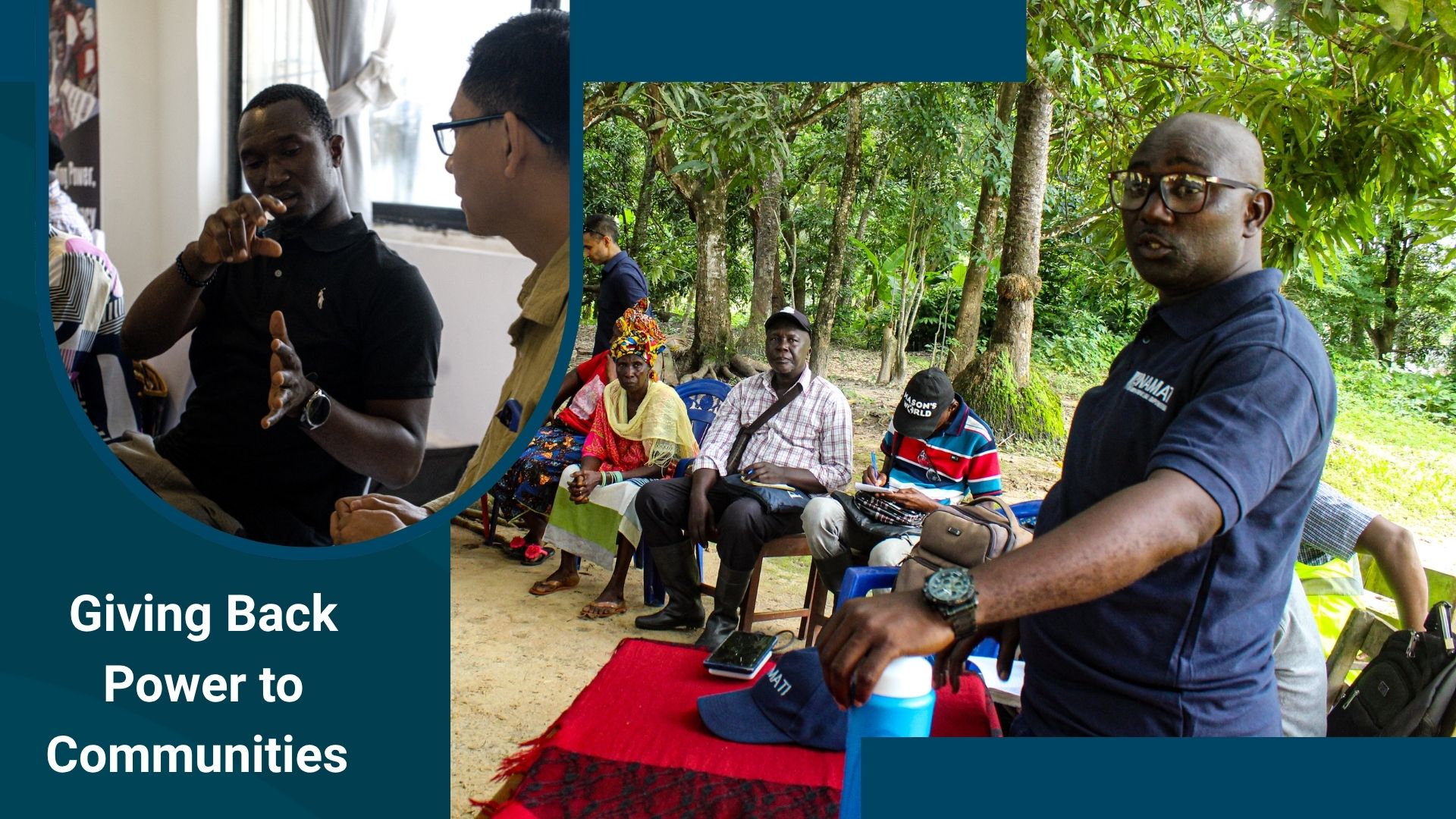
While Namati Sierra Leone has achieved significant progress in advancing legal empowerment and facilitating fairer agreements between communities and investors, the path to justice in land, environment, and climate spaces remains fraught with resistance—particularly at local government and state levels. It is within this context that Namati Sierra Leone recently convened Land, Environment, and Climate (LEC) justice teams from Kenya, India, Myanmar, the Philippines and the United States. The gathering created a space to share experiences and sharpen strategies for building, exercising, and sustaining community power.
As Managing Director of Namati’s LEC programme, Erin Kitchell, observed, “Across our work, there are significant power imbalances between communities and actors like mining companies, carbon developers, and even the government. This convening helped us unpack how to respond to that.” Central to the discussions was the need to shift leadership into the hands of communities themselves by strengthening existing governance structures. Participants emphasized the role of inclusive, participatory bylaws in defining decision-making processes, resource management, and accountability.
Equally critical was the role of organizing—bringing communities together to act collectively in the face of entrenched inequality. Reflecting on Sierra Leone’s mining challenges, Kitchell noted, “Hundreds of communities are affected by mining, and it’s hard for them to stop the destruction to their lands, houses, and health. Given the difficulty of getting regulatory action, we’re talking about bringing communities together across mining sites so they can develop common demands and expose where the law is breaking down in practice.”
In this approach lies a powerful shift: individual voices like Yeabu Sesay’s, once isolated and easily overlooked, are woven into a unified front capable of demanding accountability. As Eileen Wakesho, Director of the LEC Programme in Nairobi, Kenya, reflected, “Across our countries, communities are starting to challenge land and environmental injustice. I have learned a lot about how we can enable communities to leverage collective power into securing more progressive contracts.” “It was a unique opportunity for the Sierra Leone team to learn different strategies and approaches from the other teams that we can incorporate into our work,” notes Namati Sierra Leone’s Director in charge of Programmes, Daniel Sesay.
“For instance, we learned a lot about ground truthing from the Indian team, which is a deeper, more constructive and strategic approach to real world verification.” Ultimately, the path toward justice lies in transforming communities from passive recipients of decisions into active shapers of their own futures. When communities come together to define clear, collective demands, they begin to shift the balance of power. Though unity requires navigating diverse interests and priorities, effective organizing amplifies collective voice, strengthens negotiating power, and creates real opportunities for communities to influence decisions that shape their lives.