By Abass Mahmoud Sillah Jr
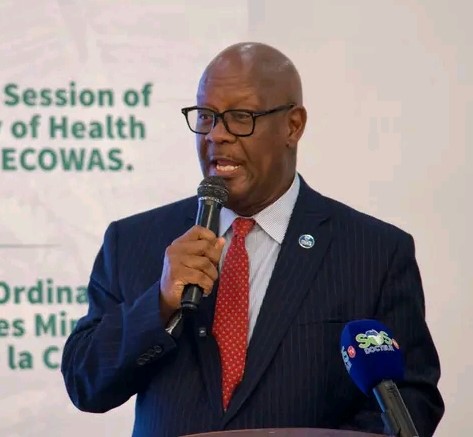
Sierra Leone’s Minister of Health, Dr. Austin Hinga Demby, has called for stronger political will and sustained investment across West Africa to combat malaria, describing the disease as one of the region’s most pressing public health challenges. Delivering a statement at a high-level regional assembly, Dr. Demby emphasized that health remains central to Sierra Leone’s national development agenda, aligned with President Julius Maada Bio’s Human Capital Development strategy. He noted that leadership at both national and regional levels must match the scale of the malaria burden confronting the continent.
“The ministers assembled here represent a shared conviction that investing in the health of our people is one of the most consequential decisions any government can make,” he said. “The theme of this year’s gathering—malaria control and elimination—is both timely and necessary.” Dr. Demby underscored the disproportionate impact of malaria on Africa, noting that the continent accounts for approximately 96 percent of global malaria cases and 97 percent of related deaths. He warned that progress in tackling the disease has stagnated since 2015, with multiple challenges converging to threaten recent gains.
Among these challenges, he cited declining development assistance, increasing climate variability that is expanding malaria transmission zones, and growing insecticide resistance, which is reducing the effectiveness of existing prevention tools. These pressures, he said, are further compounded by limited fiscal space across many African governments. “The question before this assembly is whether our political commitment is equal to the scale of the challenge,” Dr. Demby stated. Despite these obstacles, Sierra Leone has recorded notable progress in malaria control.
The Health Minister revealed that malaria deaths among children under five dropped significantly between 2022 and 2023, reflecting intensified national efforts. He also highlighted Sierra Leone’s leadership in innovation, noting that the country is among the first globally to integrate malaria vaccines into its routine immunization programme. In February 2024, the government successfully distributed eight million insecticide-treated bed nets nationwide, leveraging digital technology to enhance efficiency and coverage. “These results were achieved because malaria elimination has been treated not only as a health priority but as a development imperative requiring sustained investment,” he said.
However, Dr. Demby warned that global funding constraints could reverse hard-won gains. He cited projections indicating that a 30 percent reduction in malaria financing could lead to an additional 146 million cases and nearly 400,000 preventable deaths worldwide by 2030. He urged regional leaders to adopt resolutions that reflect the urgency of the crisis, stressing that malaria control is intrinsically linked to broader health outcomes, including reductions in maternal and child mortality. “The question is not only whether we understand what is happening, but whether we are acting decisively on the knowledge we already possess,” he added.
Dr. Demby also pointed to the potential of emerging technologies, including artificial intelligence tailored to African clinical realities, to strengthen disease surveillance and response systems across the region. Concluding his address, the Health Minister expressed confidence that West Africa possesses the tools and knowledge required to eliminate preventable deaths caused by malaria, provided there is sustained commitment and coordinated action. “We have everything we need to end preventable deaths in our region,” he said. “This assembly must be the starting point for accelerating that work.”