By Abass Mahmoud Sillah Jr
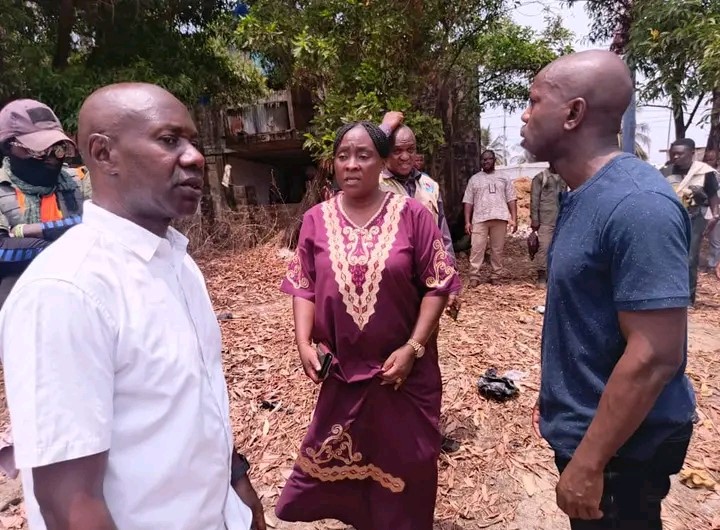
The Minister of Environment and Climate Change, Jiwoh Abdulai, has led a high-level, multi-agency delegation on a comprehensive inspection tour of key wetlands, including Aberdeen Creek and other environmentally sensitive areas across the Western Area Peninsula. The mission forms part of ongoing government efforts to assess the state of critical ecosystems and develop sustainable solutions to longstanding environmental challenges, particularly those affecting Aberdeen Creek.
The delegation brought together senior officials and technical teams from the Ministry of Environment and Climate Change, the National Protected Area Authority, the National Disaster Management Agency, and the Sierra Leone Tourist Board. Leading the NPAA team was Executive Director Sheikh Ahmed Tunis, supported by Deputy Executive Director Dwight Z.K. Sheriff, while the NDMA delegation was headed by Director Maada Salia.
Officials confirmed that the inspection carried out a broad, multi-agency assessment of wetlands across the Western Area Peninsula, focusing on evaluating environmental conditions, identifying threats, and proposing practical, long-term solutions. Aberdeen Creek emerged as a priority site requiring urgent intervention, with stakeholders stressing the need for coordinated and sustainable measures to address environmental degradation and encroachment. Particular attention was given to Aberdeen Creek, where discussions centered on resolving persistent environmental issues “once and for all.”
Key areas of focus included strengthening enforcement against illegal activities, restoring degraded wetland ecosystems, enhancing inter-agency collaboration, and promoting sustainable community engagement. Officials underscored the importance of adopting a unified approach to protect the fragile ecosystem while balancing community needs. Responding to questions on the way forward, the Executive Director of the National Protected Area Authority, Sheikh Ahmed Tunis, outlined a firm position grounded in legal enforcement and environmental restoration.
He emphasized that all wetlands and estuaries within the Western Area Peninsula are legally protected, stressing that no form of development is permitted within these designated zones. “Protected area status supersedes all competing claims,” he stated, noting that private ownership—whether based on inheritance or formal documentation—does not override environmental protection laws. The NPAA also outlined a series of immediate and long-term actions, including identifying and mapping encroached areas, demolishing illegal structures where necessary, restoring degraded ecosystems through mangrove regeneration, confiscating or repurposing materials found within protected zones, and strengthening coordination with key institutions such as the Ministry of Lands, the Ministry of Environment and Climate Change, and the Environmental Protection Agency.
Addressing land ownership concerns, Tunis revealed that fake land documents are in circulation, with suspicious cases routinely referred to the Ministry of Lands for verification. He disclosed that at least one reviewed document had been confirmed as fraudulent. He further stressed that even valid land ownership documents do not grant the right to develop within protected wetland areas. Drawing a comparison with forest reserves, the NPAA Executive Director explained that just as protected forests cannot be exploited, wetlands must also remain undisturbed. He highlighted the critical role wetlands play in national resilience, noting that they serve as natural buffers against flooding, retain water, regulate environmental balance, reduce disaster risks, protect public health, and sustain biodiversity.
Their destruction, he warned, poses significant risks to communities and the broader ecosystem. The inspection tour underscores the government’s broader commitment to halting environmental degradation, reclaiming and securing protected lands, and restoring ecological integrity for present and future generations. Officials reiterated that protecting wetlands is not only an environmental necessity but also a matter of national interest, essential for safeguarding livelihoods and ensuring sustainable development.