By Abass Mahmoud Sillah Jr
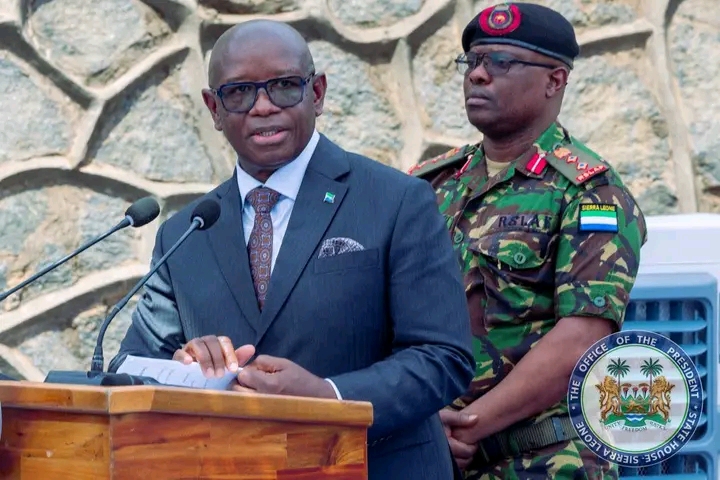
President Julius Maada Bio has delivered a sweeping keynote address declaring that Sierra Leone’s pursuit of digital sovereignty is not merely a technological ambition, but a matter of national dignity and justice for its citizens. Speaking at the commissioning of the new National Telecommunications Authority (NATCA) headquarters, the President described the facility as a transformative instrument that will safeguard the country’s digital future while ensuring inclusive access to opportunities in an increasingly connected world. “Freedom is coming,” President Bio declared. “Digital sovereignty is not a technical term—it is a matter of national dignity.”
At the heart of the new facility is a state-of-the-art Network Operating and Communications Monitoring Centre, which the President said will play a critical role in overseeing the country’s expanding digital ecosystem. With mobile money, digital banking, and online services rapidly growing, he emphasized the need for strong regulatory systems that protect citizens’ data, finances, and livelihoods. “As these services expand, citizens need the assurance that someone is watching—that the systems they trust are properly regulated and protected,” he said. “This centre provides that assurance.”
President Bio stressed that while government welcomes private sector investment and profitability, the ultimate goal is to ensure that ordinary Sierra Leoneans directly benefit from the digital economy. “We want corporations to make profit and pay their taxes,” he noted, “but we also want real, tangible benefits for our people. After all, we are a human capital development government.” He framed the new headquarters not simply as infrastructure, but as a symbol of “technological justice” for citizens who have long been excluded from modern services and opportunities.
Looking ahead, the President painted an ambitious vision for Sierra Leone in 2036—one driven by technology-enabled inclusion across sectors such as education, agriculture, healthcare, and entrepreneurship. He envisioned students accessing world-class educational content regardless of location; farmers receiving real-time market prices and transacting digitally; rural healthcare systems connected seamlessly to urban specialists; and young entrepreneurs building companies that compete across West Africa without geographical limitations. “That Sierra Leone is not a fantasy,” he said. “It is a plan—and this building is part of that plan.”
However, the President cautioned that infrastructure alone will not deliver transformation. He underscored the importance of sustained investment, accountable institutions, and collective responsibility across government, the private sector, and civil society. “Sierra Leone will not build itself,” he said. “It requires political will that outlasts election cycles and a commitment from all of us to play our part.” President Bio also used the occasion to acknowledge the origins of the NATCA headquarters project, noting that its foundation was laid in 2016 under the previous administration. He commended that decision as forward-looking and emphasized continuity in national development. “Good decisions for Sierra Leone do not belong to any single party,” he said.
“They belong to the people of Sierra Leone.” He explained that upon taking office in 2018, his administration inherited the project mid-construction and made a deliberate decision to continue it in the national interest. Progress, however, was delayed by the global COVID-19 pandemic, which disrupted supply chains and redirected government resources. “The delay was not due to neglect or indifference,” he clarified, “but a global crisis none of us anticipated.” Despite those challenges, President Bio highlighted what he described as the country’s strong pandemic response and broader development gains, citing ongoing investments in healthcare, education, agriculture, and infrastructure.
Referencing recent projects—including advanced medical equipment installations, improvements in secondary education, and increased agricultural productivity—he reiterated his government’s commitment to delivering tangible results. “We do not just promise—we deliver,” he said. He pointed to strides in food production, including rice, onions, fisheries, and poultry, as evidence of progress toward national self-sufficiency. “If that is not progress, then tell me what progress is,” he remarked.
In closing, President Bio called on NATCA staff and stakeholders across the telecommunications sector to uphold high standards of efficiency, accountability, and service delivery, emphasizing their critical role in shaping the country’s digital future. “Today, we are not just commissioning a building,” he concluded. “We are commissioning the promise we made to the people of Sierra Leone—a promise that modern services, systems, and opportunities will be accessible to all.” The ceremony was attended by senior government officials, members of parliament, representatives of the diplomatic corps, telecommunications operators, and key stakeholders in the digital and communications sector.