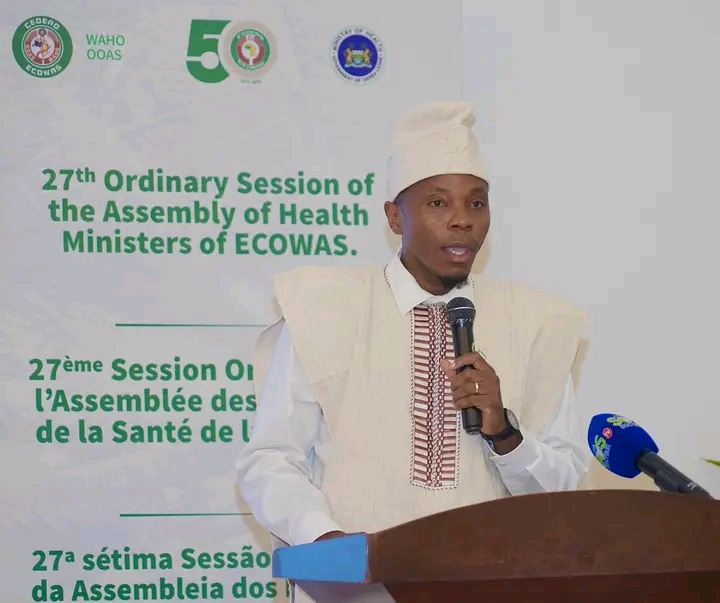
Sierra Leone’s Chief Minister, David Moinina Sengeh, has called for urgent, coordinated action across West Africa to tackle malaria, maternal mortality, and child deaths, emphasizing the need for stronger data systems and faster decision-making to improve health outcomes. Delivering a keynote address at a high-level regional health gathering, Dr. Sengeh welcomed delegates on behalf of President Julius Maada Bio and the people of Sierra Leone, expressing appreciation for their commitment to advancing healthcare across the region. “It is my distinct honor to welcome each and every one of you with genuine gratitude and a clear sense of what this moment requires of us all,” he said, noting that the health of citizens has become a defining measure of government performance across West Africa.
Dr. Sengeh highlighted that citizens across the region are increasingly demanding tangible results—particularly improvements that extend beyond urban centers into rural and underserved communities. Malaria and Preventable Deaths Still a Major Threat He described malaria as one of the heaviest disease burdens in the region, stressing its devastating impact on children and its broader economic consequences. “Malaria continues to take lives, undermine families, and weaken the workforce on which our economies depend,” he said, adding that maternal and child mortality remain critical challenges that require urgent attention. Despite these challenges, Dr. Sengeh pointed to notable progress in Sierra Leone, particularly in reducing maternal mortality by approximately 70 percent and child mortality by 30 percent in recent years, attributing these gains to strong leadership and targeted health interventions.
However, he cautioned that progress remains uneven and insufficient. “Women are still dying from causes we know how to prevent. Children are still dying from infections that functioning health systems should be able to treat,” he said. From Commitment to Action Dr. Sengeh emphasized that the gathering was not merely for reflection, but for decisive action. “We do not gather just to acknowledge the problem. We gather to act—and to commit to doing more for our people,” he stated, reaffirming a shared regional commitment to ending preventable deaths. He underscored that one of the key factors distinguishing high-performing health systems from struggling ones is the quality and use of data.
“The difference lies in the quality of information available to decision-makers and the speed at which that information is translated into action,” he said. “Health systems that see clearly and act quickly save lives.” Data, Innovation, and Regional Learning The Chief Minister called on ministers, policymakers, and partners to leverage data and digital tools to strengthen health systems and accelerate progress. He encouraged countries to share experiences and learn from one another, emphasizing that collective knowledge and collaboration are essential to addressing shared challenges. Dr. Sengeh also referenced a proposed regional charter aimed at accelerating malaria elimination and reducing maternal and child mortality, noting that digital innovation and data-driven strategies would be central to its success.
“Sierra Leone is honored to host this assembly because we believe what happens here will shape the future of our health systems and the next generation of West Africans,” he said. Formal Opening of Ministerial Session In his concluding remarks, Dr. Sengeh thanked participants for their commitment and leadership, acknowledging the responsibility they carry on behalf of their respective countries. He then formally declared the 27th Ordinary Session of the Assembly of Health Ministers of the Economic Community of West African States (ECOWAS) open.