By Staff Writer
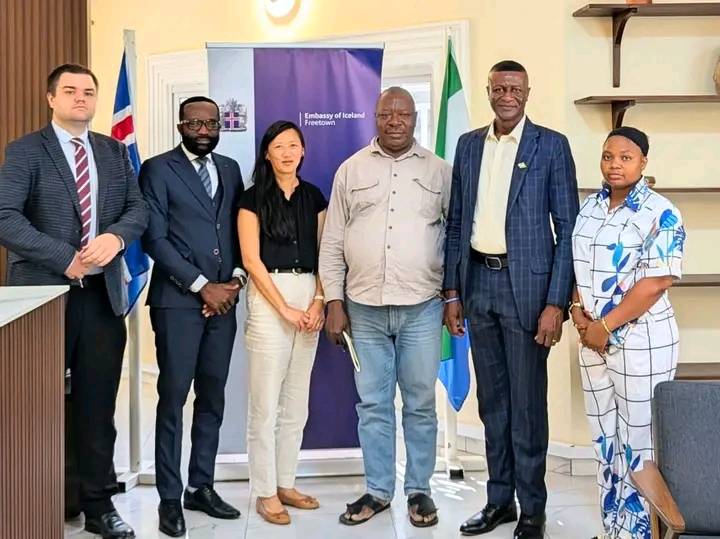
The National Disaster Management Agency (NDMA) has engaged the Icelandic diplomatic mission in a strategic dialogue aimed at strengthening collaboration on the blue economy and enhancing disaster preparedness for vulnerable coastal and riverine communities. The meeting, held at the Iceland Embassy on Fudia Terrace, Spur Loop on April 17, brought together NDMA’s senior leadership and Iceland’s Head of Mission, Ásdís Bjarnadóttir, to explore practical areas of cooperation at the intersection of environmental sustainability and disaster risk management.
Leading the NDMA delegation, Director General John Vandy Rogers, accompanied by Deputy Director General Solaiman B. Sowa and a cross-section of female staff, outlined the agency’s evolving mandate in the face of growing climate-related threats. Rogers noted that NDMA, established by an Act of Parliament in 2020 and fully operational since 2021, is tasked with coordinating national efforts in disaster preparedness, response, and recovery. He emphasized that the agency is increasingly aligning its strategies with blue economy initiatives to address emerging risks affecting marine and coastal ecosystems.
“As climate pressures intensify, particularly along our coastlines, we are deliberately integrating disaster risk management with sustainable ocean resource use,” Rogers said. “This approach allows us not only to respond effectively to disasters, but also to reduce vulnerabilities through resilient coastal development and environmental stewardship.” Expanding on this framework, Deputy Director General Sowa highlighted the economic potential embedded in Sierra Leone’s blue economy, citing fisheries, maritime trade, and coastal tourism as key growth sectors.
However, he stressed that these opportunities must be pursued alongside robust risk reduction measures. “Our coastal communities remain on the frontline of climate hazards, including coastal erosion and environmental degradation,” Sowa stated. “By embedding disaster risk reduction into blue economy investments, we can build sustainable livelihoods while safeguarding ecosystems.” In her response, Ambassador Bjarnadóttir welcomed NDMA’s integrated approach, describing it as both timely and forward-looking. She commended the agency for recognizing the intrinsic link between environmental protection and disaster resilience.
“The alignment of the blue economy with disaster preparedness reflects a strong and pragmatic vision,” she said. “Protecting marine resources and building resilient communities must go hand in hand if sustainable development is to be achieved.” Ambassador Bjarnadóttir also highlighted Iceland’s growing engagement in Sierra Leone, noting that while the embassy was formally established in 2024, Iceland has maintained partnerships in the country since 2018. These collaborations span government institutions, international organizations, and civil society actors.
Among ongoing initiatives, she referenced Water, Sanitation and Hygiene (WASH) programmes being implemented in 17 communities across five districts. These interventions are being carried out in partnership with the Sierra Leone Red Cross Society and Save the Children International, targeting improved public health outcomes and community resilience. The meeting concluded with both parties reaffirming their commitment to sustained dialogue and joint action. The partnership is expected to focus on advancing integrated approaches that link disaster resilience with blue economy development, ultimately supporting sustainable livelihoods and long-term environmental protection in Sierra Leone.