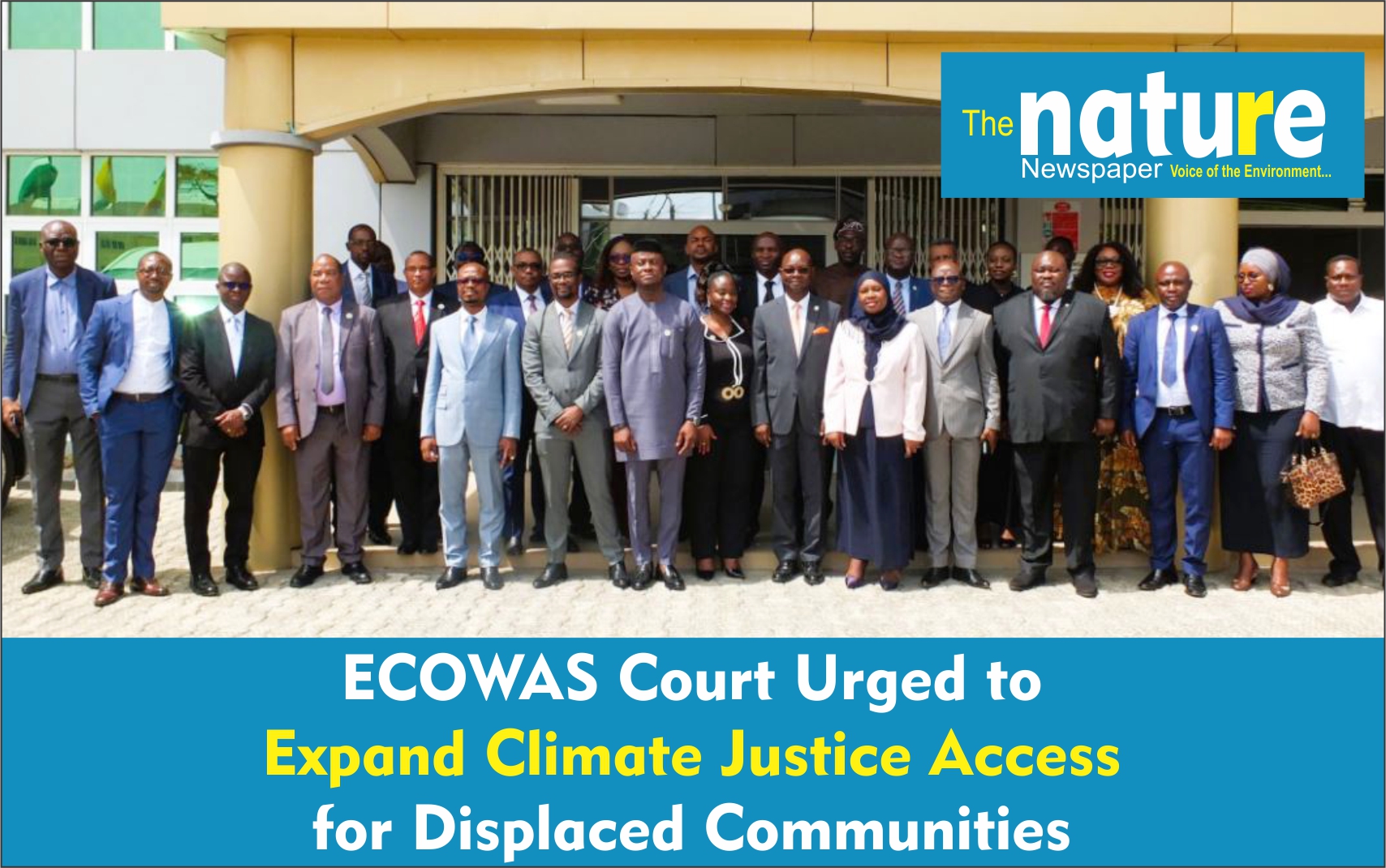
DAKAR, Senegal, September 30, 2026 the ECOWAS Court of Justice is emerging as an important avenue for communities displaced by flooding, coastal erosion and other climate-related disasters, but access to environmental justice must be strengthened to ensure affected populations and civil society organizations can effectively pursue claims, a regional law scholar has said. Kokou Serge Evelamenou, Lecturer-Researcher, Head of the Private Law Department, Faculty of Law, University of Lomé, made the observation during the ECOWAS Court of Justice International Conference at the King Fahad Conference Hall in Dakar on Thursday, September 24, 2026. Speaking under the sub-theme “Environmental Justice and Multilateral Responsibility: The Role of the ECOWAS Court in Combating Pollution and Climate-Related Damage,” Ahlin said climate change in West Africa was increasingly producing consequences that went beyond environmental damage to become fundamental rights issues. He pointed to recurrent flooding across the Gulf of Guinea, coastal erosion in countries including Togo, Benin and Ghana, and desertification in the Sahel as developments contributing to large-scale displacement. “These are all things that lead to massive displacement among the people, which actually then begs a fundamental rights issue,” he said.
Evelamenou said the ECOWAS Court had developed an important jurisprudence by treating the right to a safe and enabling environment as part of the protection of fundamental rights. He referred to Article 24 of the African Charter on Human and Peoples’ Rights, which provides for the right to an environment favourable to development, saying the ECOWAS Court had transformed the provision from a theoretical right into a basis for concrete obligations on governments. He cited cases including APDH v Côte d’Ivoire and MHD v Niger, as well as litigation concerning oil pollution in Nigeria, to demonstrate the Court’s developing approach to environmental protection and state responsibility. A key issue, he said, was access to the regional court. Evelamenou noted that the ECOWAS Court’s framework allowed individuals to approach the Court directly in human-rights matters without first exhausting domestic remedies, describing the development as significant for communities facing environmental harm. He also highlighted the position of civil society organizations, arguing that they should not necessarily be required to demonstrate a personal interest or a direct mandate from every affected victim where an environmental violation affects a wider community. “Public interest is enough ground for the admissibility of the entire community,” he said, describing the approach as one based on collective responsibility.
Evelamenou contrasted this with the French model, where standing for certain ecological claims is more restricted to accredited associations meeting specified requirements. He argued that the ECOWAS approach was better suited to the urgency of climate-related harm, particularly where affected communities may lack the resources or institutional capacity to pursue lengthy domestic proceedings. However, he acknowledged significant obstacles, including the cost of establishing causality and proving environmental damage. Such costs, he said, could place environmental justice beyond the reach of vulnerable communities already bearing the consequences of climate displacement. Evelamenou therefore called for continued strengthening of the ECOWAS Court’s environmental jurisprudence and enforcement mechanisms, arguing that rights would have limited value if communities could not secure effective remedies. As climate-related displacement grows across West Africa, the presentation positioned access to regional justice as an increasingly important part of protecting communities whose homes, livelihoods and environments are being affected by environmental change.