By Zacharia Jalloh, Ministry of Information and Civic Education
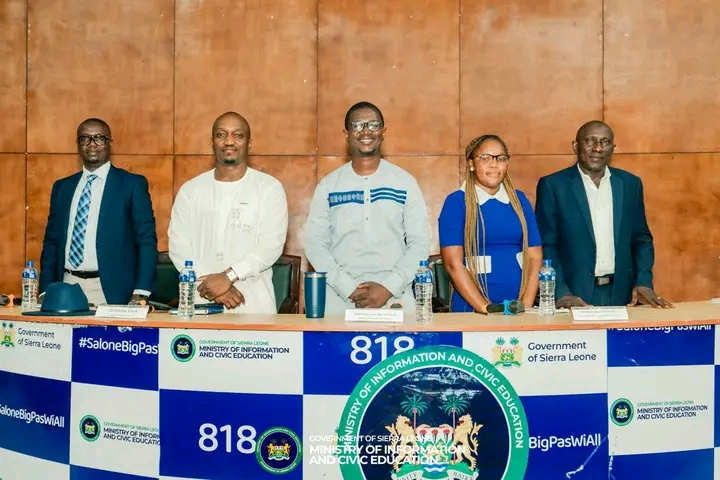
The Ministry of Information and Civic Education (MoICE) convened its weekly government press conference at the Miatta Conference Centre, Youyi Building, addressing critical national issues including electricity supply, water distribution, and public awareness of the Citizens’ Budget. The briefing brought together senior government officials, civil society representatives, and the media, offering updates on ongoing initiatives and responding to public concerns. Strategic Communications Adviser Mohamed Jaward Nyallay announced that the government’s Civic Day Series will take place in Karene District from April 13–14, 2026.
He described the initiative as a flagship engagement platform under the administration of Julius Maada Bio, aimed at strengthening direct interaction between citizens and government officials. Nyallay noted that the programme has already been successfully held in several districts, including Bombali, Port Loko, Kambia, Moyamba, Kenema, Bo, Kono, and Falaba, with upcoming engagements planned for Kailahun, Bonthe, and Pujehun. He emphasized that the series has attracted thousands of participants nationwide, providing citizens with the opportunity to ask questions, raise concerns, and contribute to governance.
Residents of Karene were urged to actively participate in the upcoming sessions. Deputy Minister of Energy I Edmond Nonie refuted allegations that electricity had been diverted from Makeni to Freetown. He described the claims as “illogical,” explaining that Freetown requires approximately 100 megawatts of electricity, while Makeni generates only about 6 megawatts. “The government will not deprive one city to supply another,” Nonie assured. He further confirmed that recent maintenance work affecting Makeni and Magburaka had been completed, with electricity supply expected to be fully restored. Providing a nationwide update, Nonie disclosed that Kambia Town has recently been electrified, with 275 households connected from previously having no access.
He outlined the current electricity distribution across key districts: Bo, Kenema, and Kono receive approximately 15MW each; Port Loko receives 1MW; Lunsar receives 1.25MW; Moyamba relies on a combination of solar and generator supply; while Kailahun, Bonthe, and Pujehun depend on generator-powered electricity. Despite these efforts, Nonie acknowledged that government expenditure on fuel to sustain electricity supply continues to exceed revenue generation. He attributed reduced electricity availability in Freetown to the dry season, noting that the Bumbuna Hydroelectric Power Station is currently producing only about 5MW—significantly below capacity.
In a move to enhance service delivery, the Ministry of Energy, in collaboration with the Directorate of Science, Technology and Innovation, has launched a chatbot system to handle electricity-related complaints and inquiries. Nonie explained that the platform will enable the Electricity Distribution and Supply Authority to process large volumes of complaints simultaneously, thereby improving response time and operational efficiency. Managing Director Mariwan Kallon outlined measures being implemented to improve water distribution nationwide. He revealed that 366 units of 10,000-litre water storage tanks have been installed across communities to reduce reliance on pipelines and minimize leakages.
Additional measures include strengthened enforcement against illegal water connections and the installation of meters on all hydrants to monitor usage and reduce losses. To ensure equitable distribution, the Guma Valley Water Company has introduced a rationing system, dividing the capital into six zones, each receiving water supply for approximately eight hours daily. Kallon also raised concerns over increasing encroachment on Guma catchment areas, warning that such activities threaten long-term water sustainability, while commending government efforts to address the issue. Chairman of the National Council for Civic Education and Democracy, Joseph Munda Bindi, announced ongoing nationwide sensitization efforts on the 2026 national budget.
He stressed that citizens have a fundamental right to understand how public funds are allocated and spent. In collaboration with the Ministry of Finance and with technical support from Oxford, the budget has been simplified into a more accessible and reader-friendly format to promote transparency and public participation. Matilda Ekan Sonsiama, Programme Officer at Accountability Now Sierra Leone, called on EDSA to improve electricity supply, particularly in the capital. She discouraged the use of postpaid meters and urged citizens to avoid illegal connections and electricity theft. Sonsiama also raised concerns over alleged misconduct by some EDSA personnel, claiming that certain officials undermine enforcement efforts by accepting bribes. She called for stronger oversight mechanisms and accountability within the institution.
The weekly press conference highlighted both progress and persistent challenges in key service delivery sectors. While government continues to roll out initiatives aimed at improving electricity, water supply, and civic engagement, concerns around sustainability, accountability, and resource management remain central to public discourse.